
Imagine billions of devices worldwide speaking different languages yet understanding each other perfectly. This digital miracle happens through a universal communication framework.
The Transmission Control Protocol/Internet Protocol suite is the basic language of online communication. It sets the rules and standards for data exchange across global networks.
Developed by the United States Department of Defense, this protocol suite ensures data is sent accurately and reliably. Its design makes sure information arrives correctly and in the right order.
Knowing these internet protocols is key to understanding computer networking basics. This knowledge is vital for designing, maintaining, and fixing modern networks.
This framework lets different systems work together smoothly. From smartphones to supercomputers, it makes global connectivity possible every day.
The Foundations of Computer Networking
Imagine trying to have a conversation where everyone speaks different languages without any translation rules. That’s what digital communication would be like without established protocols. These technical standards are the backbone of all network interactions. They ensure devices can understand each other, no matter their make, model, or operating system.
Why Protocols Are Essential for Communication
Network protocols are like a universal language for digital systems. They provide a structured framework for how data travels across networks. Without these rules, the internet as we know it wouldn’t work.
Protocols set important parameters for effective data exchange:
- Standardised data formatting – ensuring consistent interpretation
- Precise transmission timing – managing data flow efficiently
- Robust error handling – maintaining data integrity
- Secure authentication processes – verifying legitimate access
The Internet Engineering Task Force (IETF) is key in keeping these standards. This international group develops and promotes internet standards, focusing on the Internet protocol suite.
These digital communication basics make a predictable environment for diverse systems to work together. From sending an email to streaming video, every online activity depends on these protocols working together.
What is TCP/IP in Computer Network?
TCP/IP is the key system that lets devices talk to each other over networks. It’s not just one protocol but a set of them working together. This stack is the internet’s core, making it possible for different systems to talk to each other, no matter their hardware or operating systems.

The Origins and Development of TCP/IP
The TCP/IP history starts with research by the US Department of Defense’s Advanced Research Projects Agency (DARPA). In the late 1960s, DARPA began working on strong networking tech. This early DARPA networking work was the start of the modern internet.
Vinton Cerf and Bob Kahn, known as the “fathers of the internet,” were key in making TCP/IP. They tackled big challenges to make a reliable network that could link different computers. The suite was first called the Department of Defense (DOD) Internet Architecture Model, later known as TCP/IP.
A big step in protocol evolution was on January 1, 1983, known as “flag day.” On this day, ARPANET switched from the Network Control Program (NCP) to TCP/IP. This change made TCP/IP the standard for internet communication.
The US Department of Defense adopted TCP/IP in 1982, speeding up its growth. What started as a network for the military and academics became the global standard. Its design, focusing on fault tolerance, flexibility, and interoperability, helped it grow into the modern internet we know today.
This journey from a research project to a global standard shows the amazing protocol evolution that has shaped our digital world. The suite keeps getting better, meeting the growing needs of global connectivity. For more on how these protocols work in computer networks, check out this guide on TCP/IP in computer networking.
The Architecture of the TCP/IP Model
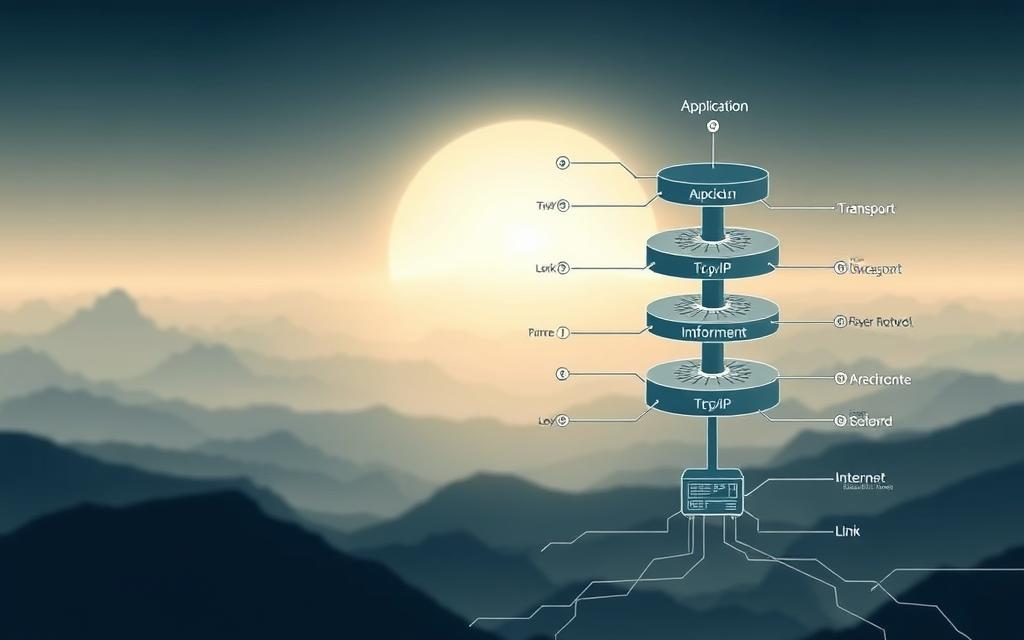
The TCP/IP model is a layered approach that is elegant in network architecture. It has four practical layers for all internet communication, unlike the OSI model’s seven layers. This structure makes data transmission efficient and maintains standards in various networks.
The Four Layers of the TCP/IP Suite
Each layer in the TCP/IP stack has its own role, working together smoothly. This makes the system modular, so changes in one layer don’t affect others. The four layers form a complete framework that has been adaptable for decades.
The link layer is the base of network communication. It connects devices and manages local networks. It uses MAC addresses and controls data frames on the physical medium.
Protocols like Ethernet and Wi-Fi are used here. They ensure data packets move between devices on the same network. This layer interacts directly with network hardware.
The Internet Layer: Routing the Packets
The internet layer is the backbone for routing packets. It moves packets across networks from source to destination. It uses IP addresses for global device identification.
Protocols like Internet Protocol (IP) and ICMP are key here. They handle packet addressing and error reporting. These ensure packets navigate complex network paths.
The Transport Layer: Ensuring Delivery
This layer ensures end-to-end communication between applications. It offers reliable transmission through TCP and fast datagram service via UDP. It handles segmentation, flow control, and error recovery.
TCP guarantees delivery with acknowledgment and retransmission. UDP is faster but doesn’t guarantee delivery, ideal for real-time apps. Both use port numbers for directing data.
The Application Layer: User Interfaces
The application layer is the interface between network services and user apps. It includes protocols like HTTP, SMTP, and FTP. These define how apps communicate over the network.
Protocols in this layer don’t include the apps themselves but the standards they use. This separation helps apps evolve while keeping networks compatible.
When comparing OSI and TCP/IP models, TCP/IP’s layers map to OSI layers in some cases. The application layer in TCP/IP includes OSI’s presentation and session layers. This makes TCP/IP efficient and widely used in networks.
The TCP/IP layers work through encapsulation. Data moves down the stack for transmission, with each layer adding headers. The reverse happens during reception, with each layer processing its header before passing data up.
Key Protocols within the TCP/IP Suite
The TCP/IP suite has many protocols working together. Two are key, handling different parts of data sending. They make a complete system for network talks.
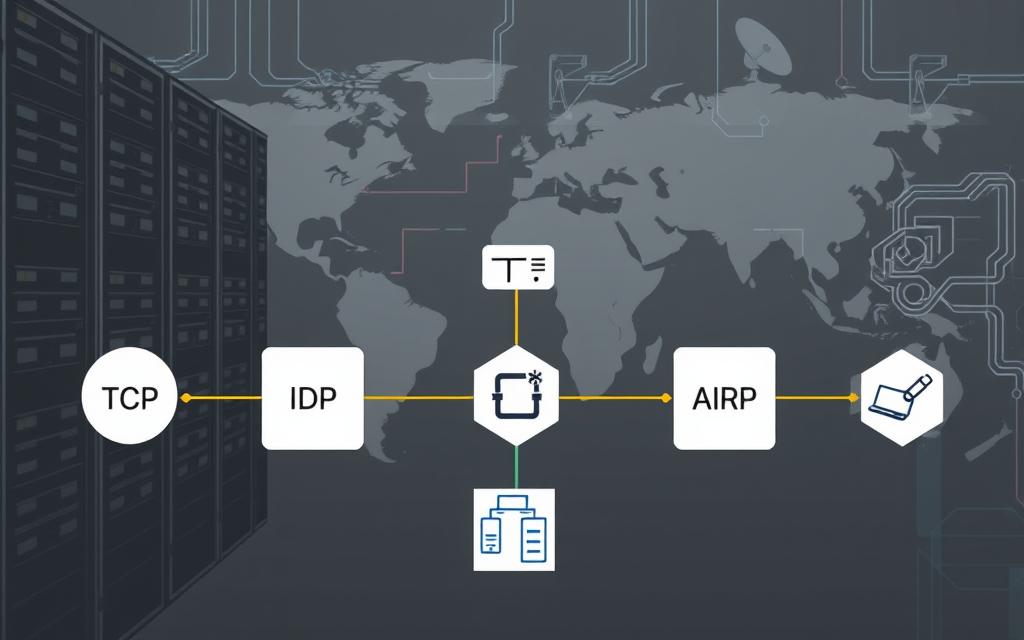
Transmission Control Protocol (TCP)
The TCP protocol is a connection-oriented standard. It sets up a reliable path for data before it’s sent. This ensures data arrives whole and in order.
TCP uses several ways to keep data reliable:
- Sequence numbering for packet reassembly
- Acknowledgement system for received data
- Flow control to manage transmission rates
- Error detection through checksums
Its careful method makes TCP great for precise needs. Email, web browsing, and file transfers all use it for reliable data delivery.
“TCP provides the reliability that modern applications demand, ensuring data integrity across unpredictable network conditions.”
Internet Protocol (IP)
The IP protocol is a connectionless system. It focuses on addressing and routing packets without a connection. Each packet can take different paths to its destination.
IP does two main things:
- Addressing using IPv4 or IPv6 systems
- Routing through interconnected networks
This protocol doesn’t promise delivery or keep packets in order. Its simplicity helps in efficient routing across various networks.
Understanding Protocol Differences
TCP and IP work together perfectly. IP handles addressing and routing, while TCP ensures reliable delivery. Their teamwork makes a strong communication system.
| Characteristic | TCP Protocol | IP Protocol |
|---|---|---|
| Connection Type | Connection-oriented | Connectionless |
| Reliability | High (with acknowledgements) | Best-effort delivery |
| Packet Sequencing | Maintains sequence | No sequence control |
| Primary Function | End-to-end data integrity | Addressing and routing |
These protocol differences show how each does its own job. Together, they are the core of modern TCP/IP communications. They support everything from simple messages to complex data streams.
The way these protocols work together shows smart network design. Each does its best, making a system that’s more than just the sum of its parts.
How TCP/IP Facilitates Internet Communication
Modern digital exchanges rely on TCP/IP’s data packet system. This system ensures information travels reliably across different networks. It’s the backbone of our global connectivity.
The Journey of a Data Packet
When you send information online, TCP/IP breaks it into smaller packets. Each packet travels through the network, possibly taking different paths. This way, if there’s an error, only the affected packet needs to be resent.
The process starts at the application layer, where data is first packaged. As it moves down the four-layer model, each layer adds headers. These headers include addressing and control details. This layered approach ensures your data is delivered correctly.
Routers check IP addresses to find the best path for each packet. They make decisions based on the network’s current state. This makes the internet communication process dynamic and efficient.
Transmission Control Protocol ensures data is delivered reliably. It starts with a three-way handshake to set up a connection. This handshake confirms both devices are ready to communicate.
For example, when you send an email using SMTP, your client breaks the message into packets. These packets travel through networks until they reach the mail server. TCP makes sure all packets arrive, asking for retransmission if any are missing.
The client-server model is at the heart of this system. Clients ask for services, and servers respond. This model allows for efficient communication across millions of devices. The system’s beauty lies in its ability to handle complexity while staying reliable.
The Importance of TCP/IP in Modern Computing
In today’s world, TCP/IP is key to our connected lives. It’s used everywhere, changing how businesses work and how we talk to each other around the globe.

TCP/IP’s Role in Business and Global Connectivity
TCP/IP is open to all, not owned by one company. This openness leads to more innovation and use. It makes it fair for all businesses to use strong networking tools.
Businesses love TCP/IP because it works with all systems and hardware. This makes it easy to mix old and new tech, saving money and time.
Key business uses include:
- Enterprise networking solutions that connect multiple office locations
- Cloud computing integration for scalable resource allocation
- E-commerce platforms handling secure transactions
- Remote access systems supporting flexible work arrangements
TCP/IP helps data travel fast through networks. This is key for things like video calls and fast financial trades.
It also supports new tech like smart devices and mobiles. Billions of devices use TCP/IP to talk to each other worldwide.
As one expert says:
“TCP/IP’s adaptability has allowed it to evolve alongside technological advancements while maintaining backward compatibility with existing systems.”
Global connections rely on strong internet. Things like international talks, data sharing, and web services all use TCP/IP. It’s the internet’s common language, helping it grow and improve.
TCP/IP is also key for safe business dealings. It’s used for things like online banking and health data. It’s the base for secure digital talks worldwide.
Conclusion
TCP/IP is key to how we communicate online. It makes sure data gets from one place to another safely. This is thanks to its layered design.
The Internet protocol suite has been around for a while. It’s changed to keep up with new tech. Its way of sending data packets helps our digital world grow.
TCP/IP keeps getting better to meet new needs. It tackles issues like keeping data safe and handling more traffic. This makes it a vital part of our networks.
TCP/IP is used in all sorts of online activities. It helps with sending emails and using cloud services. As technology advances, TCP/IP will keep helping us stay connected.
FAQ
What is TCP/IP in computer networks?
TCP/IP is a set of communication protocols. It’s the foundation of the internet and network communication. It helps devices exchange data reliably and efficiently across different networks.
Why are protocols essential in computer networking?
Protocols set rules for data exchange. They ensure devices, operating systems, and applications can communicate well. This is key for modern digital connectivity.
How did TCP/IP originate and develop?
TCP/IP started in the late 1960s and early 1970s. Vinton Cerf and Bob Kahn led the development. It evolved from ARPANET’s Network Control Protocol and was adopted by the US Department of Defense in 1982.
What are the four layers of the TCP/IP model?
The TCP/IP model has four layers. The Link Layer handles physical connections and hardware addressing. The Internet Layer manages IP addressing and routing. The Transport Layer ensures reliable data delivery. The Application Layer interfaces with user applications.
What are the key differences between TCP and IP?
TCP is connection-oriented and ensures reliable data delivery. IP is connectionless and handles packet addressing and routing. Together, they enable robust data communication.
How does TCP/IP facilitate data transmission over the internet?
TCP/IP uses encapsulation to package data with headers at each layer. Packets are routed by IP addresses. TCP ensures data arrives intact through the three-way handshake and sequencing.
What role does TCP/IP play in modern business and global connectivity?
TCP/IP supports enterprise networking, cloud computing, and e-commerce. It’s key for remote access and emerging technologies like IoT and mobile computing. Its open standards foster innovation and global communication.
How does TCP/IP compare to the OSI model?
TCP/IP has a four-layer architecture, while OSI has seven. Both standardise communication through abstraction. TCP/IP is more practical and widely used in real-world networks.
What is the significance of IP addressing in TCP/IP?
IP addressing identifies devices on a network and helps routers forward packets. It’s essential for routing and ensures data reaches its destination.
How does TCP ensure reliability in data transmission?
TCP uses acknowledgements, retransmissions, sequencing, and flow control. This guarantees data is delivered completely and in order. It’s ideal for applications needing high reliability, like web browsing and email.


 By
By